
WhatsApp:+86 15236742901

Email:sale@xxdahan.com


WhatsApp:+86 15236742901
Email:sale@xxdahan.com
Thursday February-26 2026 15:53:55
Test Sieve For Cement Fineness Testing are common screening tools used in cement production, quality inspection, and engineering construction to determine the fineness of cement particles. The particle size of cement affects hydration rate, strength gain, setting time, and workability during construction, and is also an indicator of cement quality.

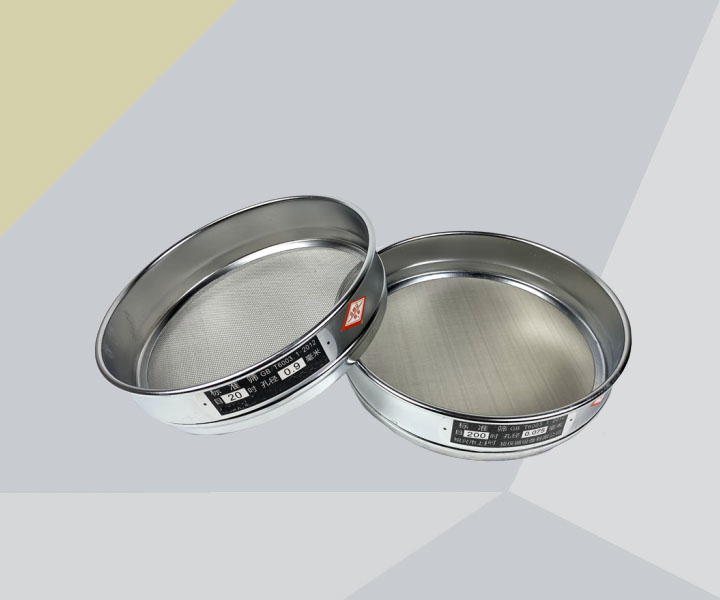
Cement fineness testing sieves typically use stainless steel or brass for the sieve frame and mesh, ensuring corrosion resistance and minimal deformation. The products undergo dimensional calibration and precision testing to ensure uniform sieve openings and a flat sieve surface. According to standards such as GB/T 1345 and ASTM C430, standard square-aperture test sieves can be used to test cement fineness. Commonly used sieve sizes are 0.080mm and 0.045mm. For finer testing, 0.032mm sieves are also used. 80μm sieves are mostly used for routine testing, while 45μm sieves are suitable for high-performance cement and engineering quality control.
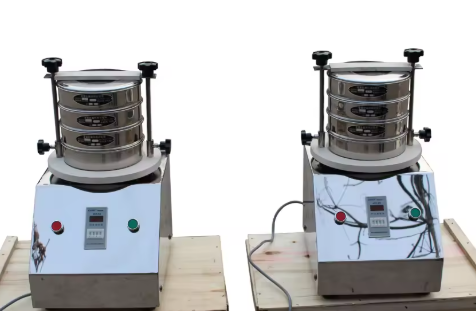
Cement fineness testing uses a standard-aperture sieve to separate cement particles of different sizes. The fineness of the cement is represented by the percentage of the material remaining on the sieve. Common methods include negative pressure sieving, water sieving, and manual sieving. Negative pressure sieving yields stable results with minimal variation in repeated tests. The procedure involves securing the test sieves to the sieve analyzer. Weigh 25g of cement onto an 80μm sieve and 10g onto a 45μm sieve, placing them in clean sieves and sealing them. After starting the machine, it automatically sieves under the set negative pressure and time. Fine particles pass through the sieve and are sucked away, while coarse particles remain on the sieve. After the test, weigh the residue and calculate the percentage of residue using a formula. The lower the percentage, the finer the cement. During operation, the instrument and sieves must be clean and unclogging, and the environment must be kept dry to prevent the cement from becoming damp and clumping, which would affect the results.
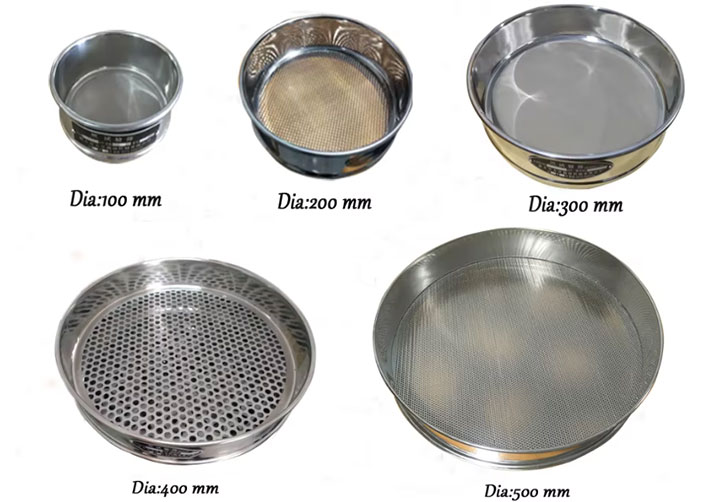
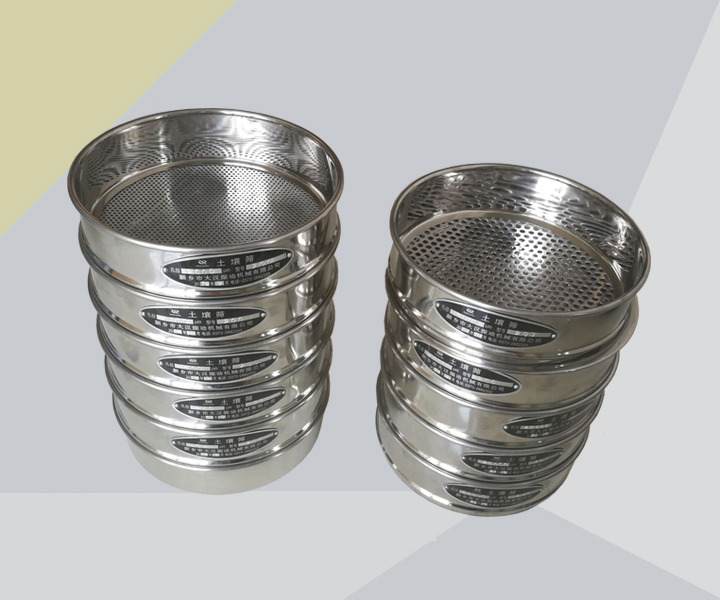
Test Sieve For Cement Fineness Testing can be categorized into three types based on structure and application: negative pressure sieves, water sieves, and manual dry sieves. All are standard circular sieves. Negative pressure sieves have sealed sieve covers and negative pressure interfaces, allowing them to be used with corresponding sieve analyzers for stable and fast laboratory testing. Water sieves utilize water flow for sieving, suitable for cement samples prone to clumping that require wet sieving. Manual sieves rely on gentle tapping and vibration by hand, typically used for preliminary inspections at construction sites. The aperture sizes of these test sieves are manufactured according to GB/T 6005 and ISO 3310-1, with 80μm and 45μm being the most common. The sieve frame diameter is uniformly 150mm, and the height and interfaces are standardized, allowing for compatibility with various sieve analyzers. Fine sieves generally refer to test sieves with an aperture of 45μm or less. These sieves have a finer mesh and require more stringent testing standards, and are primarily used for particle size control in ultrafine cement and specialty cements.
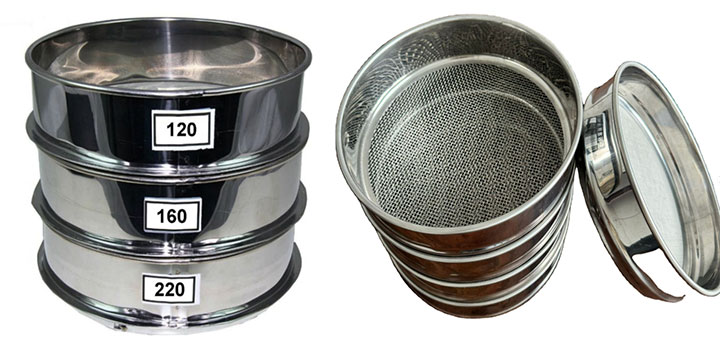
| Parameter Category | Typical Parameter | Technical Description |
| Sieve pore size | 90 μm (commonly used) | Common standard sieve in GB / ISO |
| Fine sieve pore | 45 μm | Commonly used in ASTM C430 |
| Sieve frame diameter | 200 mm | Standard test sieve size |
| Sieve material | Stainless steel mesh | Corrosion-resistant, stable pore size |
| Vibration time | 2–3 min | Mechanical vibration sieve |
| Sample mass | 25 g | Standard weighing |
Test Sieve For Cement Fineness Testing is not just a tool for sieving cement powder; it plays a significant role in cement quality control. It can measure the amount of cement remaining on the sieve, determining whether the cement's fineness and strength grade meet requirements, and helping to determine if the batch of cement is usable. Manufacturers can also adjust the operation of grinding equipment based on the sieve results, controlling the size distribution of cement particles for a more efficient production process. Besides ordinary Portland cement, this test sieve can also be used to test the fineness of common building powders such as slag cement, pozzolanic cement, and fly ash, facilitating comparison of the particle state of different materials and providing a basis for subsequent construction and material matching.
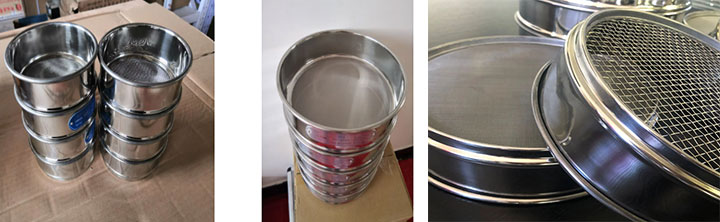
The price of Test Sieve for Cement Fineness Testing varies depending on the material, sieve mesh size, dimensions, and brand. A common 80μm stainless steel test sieve costs between $25 and $45 per sieve. A 45μm sieve is more difficult and expensive to manufacture, costing between $35 and $60 per sieve. A complete set with calibration certificates, including both 80μm and 45μm sieves, costs between $70 and $120. Sealed sieves used with negative pressure sieve analyzers offer a more complete structure and cost between $40 and $75 per sieve.
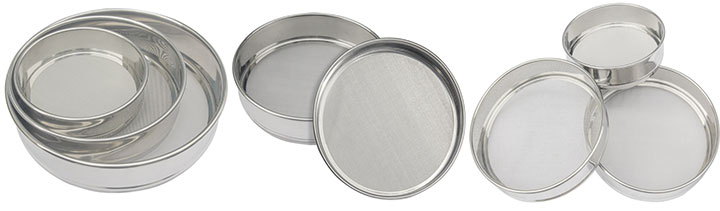
Test Sieve for Cement Fineness Testing has many practical applications in the cement production and construction industries. Some large-scale cement companies use 80μm and 45μm test sieves in their production processes to test the fineness of different batches of cement. Based on the results, they adjust the operation of their production equipment to ensure stable fineness of the cement leaving the factory. Building materials testing institutions use these sieves for testing, and the data obtained can be used in project acceptance to reduce potential concrete quality problems caused by cement fineness issues. Universities and research institutions also use them for related research, analyzing cement particle size distribution and adjusting material ratios to improve the durability of concrete during use.
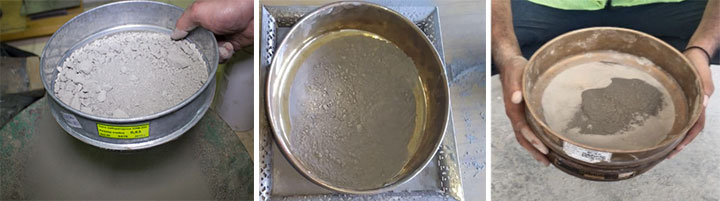
Test Sieve for Cement Fineness Testing uses 80μm or 45μm square-hole sieves to sieve cement particles, thereby determining the fineness of the cement. These test sieves come in different forms, such as negative pressure sieves and water sieves, to adapt to different testing scenarios and operating conditions. From the sieve material and manufacturing process to the calculation of subsequent correction factors, every step affects the final test results. It is used in cement production, construction site testing, scientific research experiments, and quality supervision, providing support for the structure and use of building projects based on stable test results.
Feb 26, 2026
Test Sieve For Cement Fineness Testing
Test Sieve for Cement Fineness Testing is a screening tool used in cement production, quality inspect...
Feb 24, 2026
Stainless Steel Laboratory Test Sieve
Stainless Steel Laboratory Test Sieve is a sieving tool used to analyze particle size. It can separat...
Feb 11, 2026
Test sieves for laboratory use can cover sieving needs from ultrafine powders to coarse particles, an...
Feb 11, 2026
Precise test sieves are precision screening instruments used for particle size detection, grading, an...

Then we look forward to hearing from you