
WhatsApp:+86 15236742901

Email:sale@xxdahan.com


WhatsApp:+86 15236742901
Email:sale@xxdahan.com
Wednesday May-20 2026 16:46:05
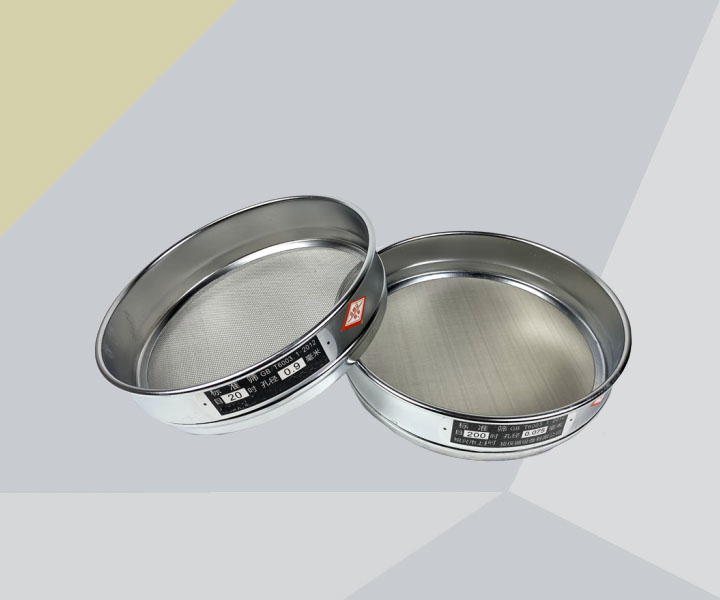
Clay Powder Test Sieve is an experimental device used to determine the particle size of clay powder. It separates particles of different sizes through physical sieving, thus revealing the fineness and uniformity of the clay powder. The sieve mesh size ranges widely, covering from 20μm to 2000μm, with common sizes including 38μm, 45μm, 53μm, 75μm, 150μm, 300μm, and 1mm, capable of handling clay powders from ultrafine to coarse. During operation, these sieves are typically tested according to international standards such as ISO 3310 series, American ASTM E11, or Chinese GB/T 6003.1-2012, allowing for data reference and comparison.
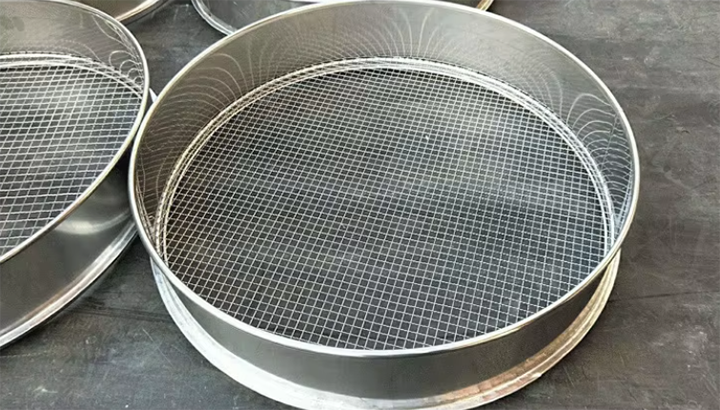
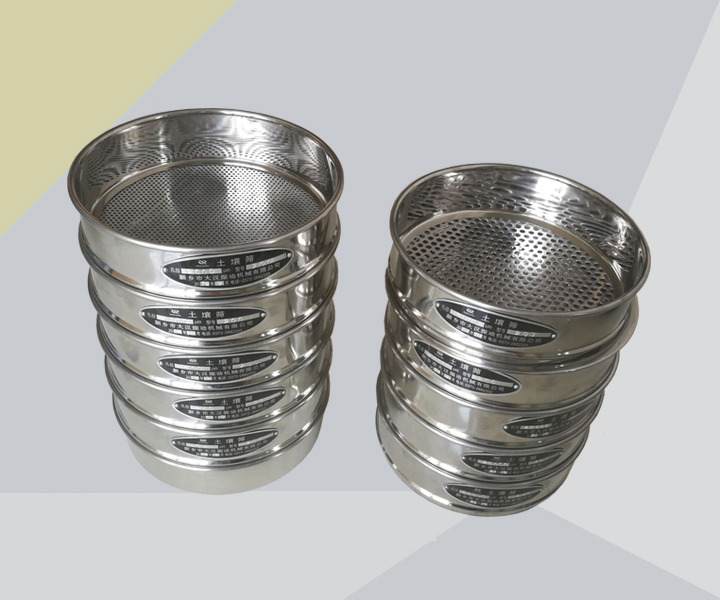
In terms of materials, the sieve mesh is often woven from 304 or 316L stainless steel, which is wear-resistant and corrosion-resistant, and the mesh is not easily deformed. The sieve frame is usually made of stainless steel or brass, providing a stable structure. The sieve frames are available in diameters of 200mm, 300mm, and 75mm, with a height typically around 45mm or 50mm. This allows for the placement of an appropriate amount of sample while providing sufficient space for the clay powder, enabling particles to move freely during sieving and preventing clogging or overflow.
When using a clay powder test sieve for clay powder sieving, first prepare several layers of test sieves with different apertures, typically stacked from largest to smallest aperture. Place a receiving tray at the bottom and a sieve cover on top. Then prepare the sample: weigh a certain amount of dry clay powder, generally between 50g and 200g, depending on the size of the sieve frame and standard requirements. Pour the powder into the top sieve.
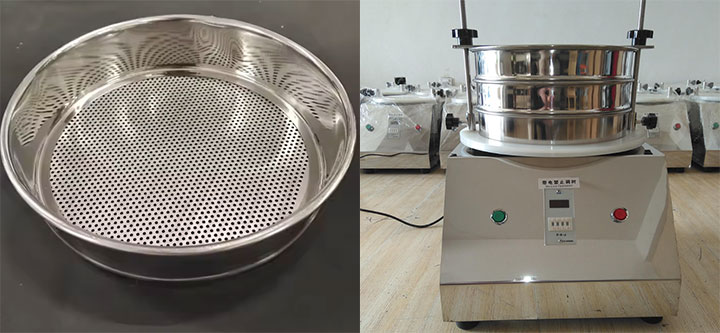
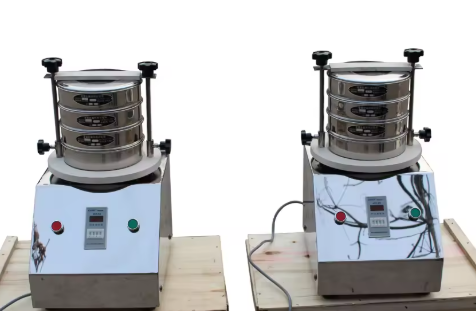
Next, place the entire sieve assembly on a vibrating screen, such as a top-impact, tapping, or electromagnetic vibrating screen. Set the sieving time; dry sieving typically takes 15 to 20 minutes. After starting the machine, the sieve will vibrate or tap to move the clay powder continuously on the screen. Particles smaller than the aperture will fall to the lower layer, while larger particles will remain on their respective screen surfaces.
After sieving, turn off the machine first, carefully remove the sieve cover, and then remove the sieve frames layer by layer. Gently brush the remaining clay powder onto weighing paper or a balance pan with a brush to weigh it. By calculating the amount of powder left on each sieve layer, a particle size distribution chart of the clay powder can be drawn, clearly showing the proportion of particles of different sizes.
For ultra-fine clay powder (such as Kaolin or Bentonite finer than 75μm / 200 mesh), dry sieving often fails due to electrostatic agglomeration and mesh blinding. In this case, Wet Wash Sieving (according to ASTM C325) is highly recommended. It uses water or deflocculants to wash fine particles through the sieve cloth gently, ensuring accurate particle size analysis without damaging the mesh.
| Mesh | Aperture (mm) | Aperture (μm) | Suitable Materials |
| 5 mesh | 4.000 | 4000 | Very coarse particle screening |
| 10 mesh | 2.000 | 2000 | Coarse sand, crushed particles |
| 20 mesh | 0.850 | 850 | Granular fertilizers, large-particle powders |
| 40 mesh | 0.425 | 425 | Medium-fine powder, relatively coarse powder |
| 60 mesh | 0.250 | 250 | Fine powder |
| 80 mesh | 0.180 | 180 | Finer powder |
| 100 mesh | 0.150 | 150 | Clay powder, fine powder |
| 120 mesh | 0.125 | 125 | Finer powder |
| 200 mesh | 0.075 | 75 | Ultra-fine powder |
| 300 mesh | 0.050 | 50 | Very fine powder |
| 325 mesh | 0.045 | 45 | Ultra-fine powder |
| 400 mesh | 0.038 | 38 | Ultra-fine powder screening |
The design of the Clay Powder Test Sieve carefully accounts for the unique physical properties of clay, which is highly hygroscopic, prone to electrostatic charges, and easily agglomerates. Since fine clay particles tend to clump together or stick to the wire cloth—clogging the pores and leading to inaccurate, oversized particle data—proper sample preparation and environmental control are critical. Samples must be thoroughly dried before testing, and the laboratory environment should maintain moderate humidity while being free from strong winds and airborne dust. To solve the notorious mesh blinding and static issues common in fine clay analysis, Dahan incorporates premium, smooth-surfaced stainless steel mesh to reduce friction. Furthermore, for ultra-fine clay testing, we highly recommend integrating an Ultrasonic Sieve Shaker or utilizing rubber bouncing balls/rings within the sieve frame. The ultrasonic waves effectively break down agglomerates and eliminate static electricity, ensuring that fine clay powders pass through smoothly to reflect the true, reliable particle size distribution.
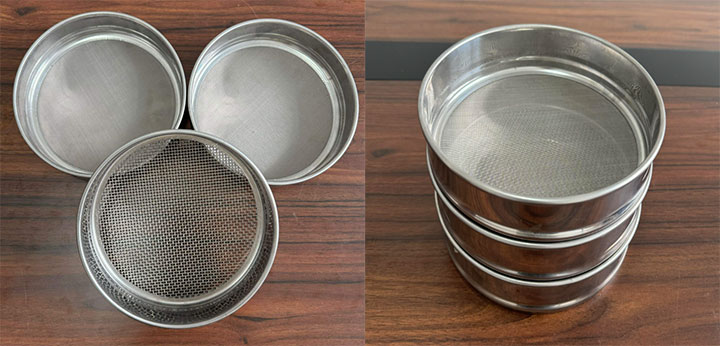
Clay Powder Test Sieve is typically used in clay-related production, research and development, and testing processes. In clay mining and processing companies, it can be used to inspect incoming raw materials, control the quality of processing, and test finished products before they leave the factory. By sieving, it can understand the particle size distribution of the powder and determine whether it is suitable for production or customer use. In geological and mineral testing institutions, this equipment helps analyze clay samples, providing detailed particle size data for mineral exploration and quality assessment. In universities and research laboratories, the Clay Powder Test Sieve is used in clay material research and development experiments, studying the impact of particle size on material properties by classifying powders of different sizes. It is also commonly used in the ceramics, building materials, coatings, rubber, and plastics industries to check the particle size of incoming raw materials, ensuring they conform to production formulas and facilitating subsequent production processes.
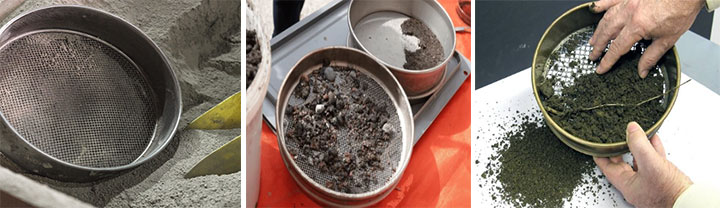
In a ceramics company processing raw materials for daily-use ceramics, the Clay Powder Test Sieve was used to test the particle size of kaolin powder, separating it into 325 mesh, 400 mesh, and 500 mesh grades. By blending powders of different particle sizes, the plasticity and sintering density of the ceramic body were improved, cracking and deformation problems were reduced, and the product qualification rate increased by approximately 8%. In a geological testing center, this test sieve was used to determine the proportion of bentonite with different particle sizes when analyzing bentonite samples from a specific region, providing reference data for mineral development and process design. This case study demonstrates how test sieves help users understand the particle size distribution of powders in actual production and experiments, leading to more stable subsequent use and product performance.
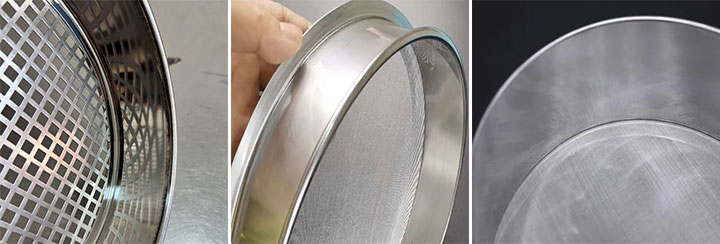
The Clay Powder Test Sieve is a fundamental tool for detecting the particle size of clay and similar powders. Through its appropriately sized sieve frame, smooth mesh material, and standardized operating procedures, it allows users to understand the particle size distribution of powders. During use, dry or wet sieving can be employed to separate the sample into layers, clearly displaying particles of different sizes. Because clay is prone to moisture absorption and adhesion, the sample must be dried before operation, and the experimental environment must be kept dry and stable to ensure reliable data. Whether in ceramics, refractory material processing, or geological exploration laboratories, this test sieve helps analyze the structure of clay powders, solve problems encountered in production or experiments, and make it easier to control material performance and final product quality.
May 20, 2026
Clay Powder Test Sieve covers stainless steel laboratory sieves (20μm-2000μm) complying with ASTM E...
May 16, 2026
pharmaceutical powder test sieve
pharmaceutical powder test sieve is a tool used to test pharmaceutical powders. Its manufacturing pro...
May 16, 2026
Test sieve for pharmaceutical powder
Test sieve for pharmaceutical powder is a special equipment used in the pharmaceutical industry for a...
May 15, 2026
flour particle size analysis evaluates granularity profiles using ISO 3310-1 standards. It ensures mi...

Then we look forward to hearing from you