

WhatsApp:+86 15236742901

Email:sale@xxdahan.com


WhatsApp:+86 15236742901
Email:sale@xxdahan.com
Wednesday September-09 2026 16:40:07
Ultrasonic test sieves are high-precision sieving equipment widely used in modern laboratories, university research and fine powder industries. By applying high-frequency low-amplitude ultrasonic vibration to the sieve mesh, they effectively solve common problems including mesh blinding, static adhesion and particle agglomeration for fine powders typically ranging from 100 mesh to 630 mesh.
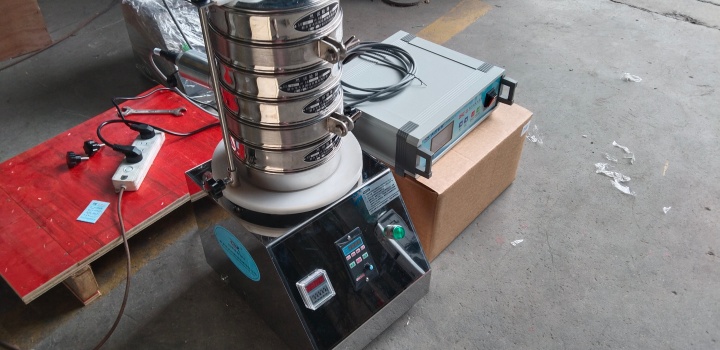
As high-precision instruments, ultrasonic test sieves require regular scientific maintenance and proper cleaning. Improper care will reduce sieving accuracy and shorten the service life of transducers and expensive precision sieve frames. This article covers standardized cleaning procedures and best-practice routine maintenance to help you maximize equipment performance.
Ultrasonic test sieves convert electrical energy into mechanical vibration through high-frequency transducers and transfer vibration directly to the sieve mesh. This design enables efficient processing of ultra-fine powders that conventional vibratory sieves struggle to handle.
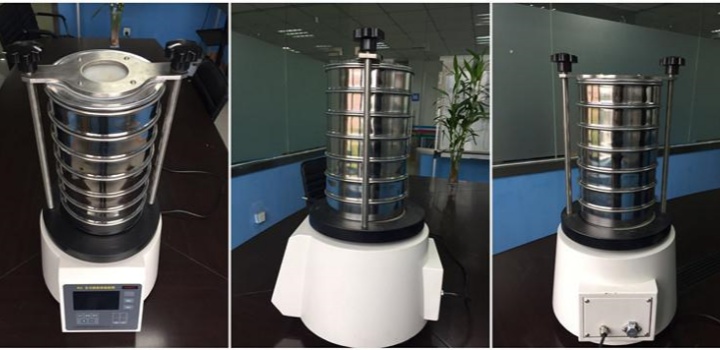
Due to the fine mesh openings and sophisticated structure, harsh cleaning methods or improper operations can cause irreversible physical damage to transducers and sieve meshes. Standardized maintenance procedures are therefore essential.
Reduced sieving efficiency and lower material passing rate usually indicate clogged sieve mesh. Follow the standardized safe cleaning steps below.
Power Off and Safety Preparation
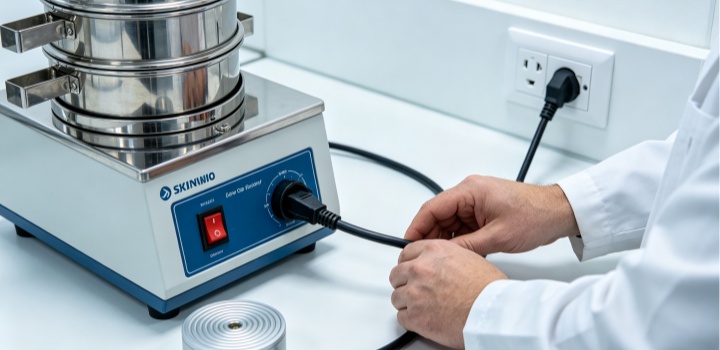
Before any cleaning or disassembly work, cut off power to the ultrasonic generator and disconnect the cable between transducer and power supply. Never perform maintenance while the unit is powered on to prevent circuit damage and electric shock hazards.
Conventional Dry Cleaning
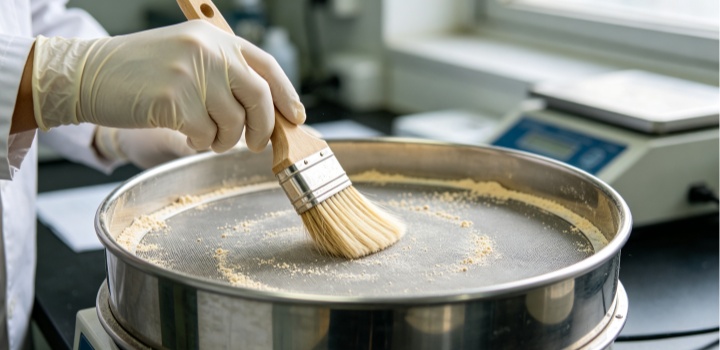
Do not use wire brushes, screwdrivers or other sharp metal tools to remove residual loose powder. Use a dedicated soft nylon brush and gently sweep dry residues along the texture of the mesh surface and edges.
Ultrasonic Bath Cleaning for Stubborn Contaminants
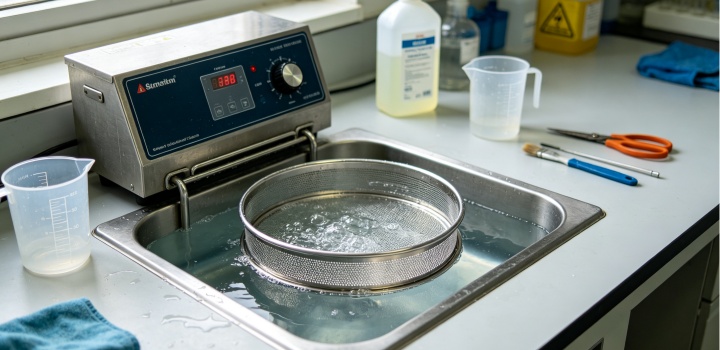
For strongly adhered particles trapped inside micro-openings, use an independent ultrasonic cleaning bath:
Place the sieve frame into the cleaning tank.
Apply neutral cleaning agent. Avoid strong acid or alkaline solutions which may corrode stainless steel and dissolve adhesive around sieve frames.
Keep cleaning duration within 5-10 minutes. Excessive cavitation may damage fine mesh wires.
Thorough Drying and Inspection
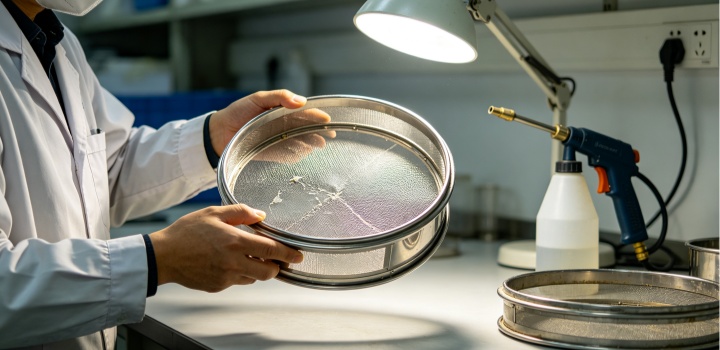
After cleaning, blow moisture out of mesh openings with clean compressed air or air-dry the sieve in a cool well-ventilated area. Do not reinstall the sieve frame until the mesh is completely dry. Inspect the mesh carefully for looseness, deformation or damage during drying.
Correct cleaning alone is not enough. Daily management directly determines equipment service life.
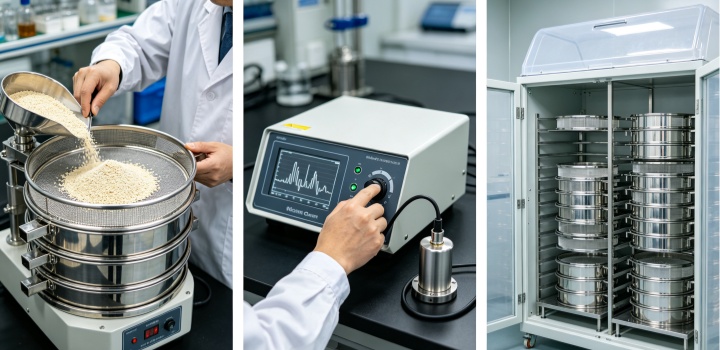
Control workload: Avoid overloading and continuous feeding which may overheat transducers and high-frequency generators. Apply moderate and even sample feeding for each test run.
Resonance frequency calibration: Periodically verify frequency matching between ultrasonic power supply and transducers. Keep the system working at optimal resonance point for maximum sieving efficiency.
Proper storage environment: Fully clean and remove sieve frames for long-term storage. Store equipment inside a dedicated instrument room that remains dry, dust-free and free of corrosive fumes.
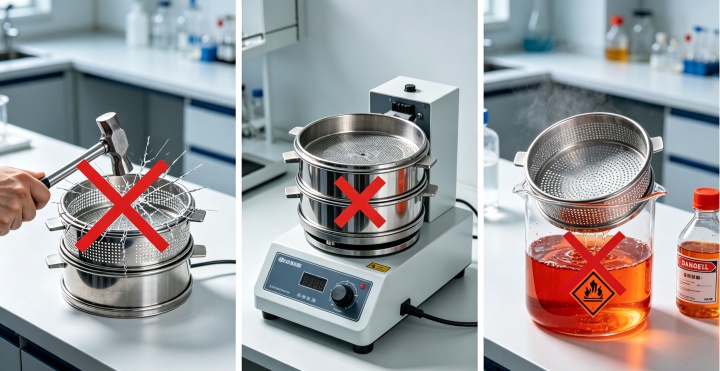
Prevent unnecessary equipment damage by avoiding these improper operations:
Violent tapping: Never tap sieve frames against hard objects to dislodge clogged particles.
Long-time no-load high-intensity ultrasonic operation: Running high-power ultrasonic vibration without material buffer accelerates component wear.
Misuse of chemicals: Do not soak sieve assemblies in strong acid, strong alkali or aggressive organic solvents. Such chemicals will degrade sealing gaskets and cause transducer detachment.
A: Cleaning frequency depends on material properties. For sticky, moisture-absorbent or easily-clogged powders, perform dry cleaning after every test or shift. Carry out ultrasonic bath cleaning periodically according to clogging conditions.
A: Medical or industrial ethanol is acceptable for partial wiping and cleaning for water-insoluble or oily materials. Make sure alcohol fully evaporates before reassembling and running the equipment.
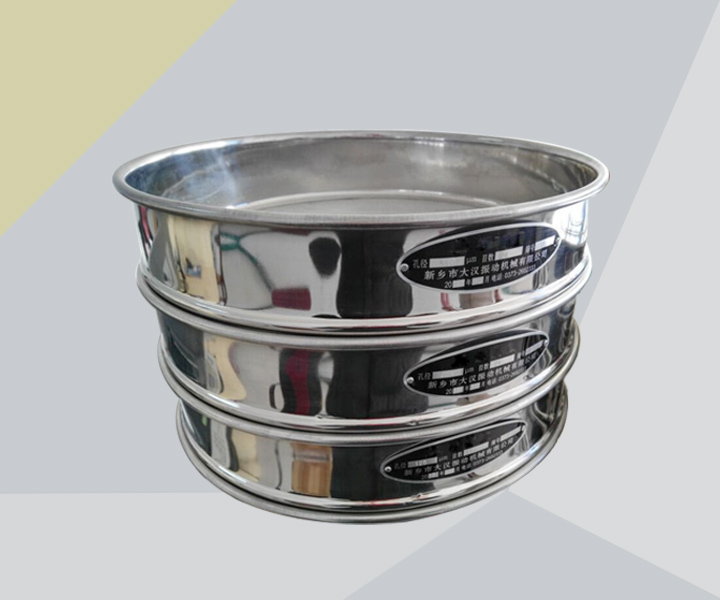
Screening particle size: 0.025-3mm
Price: $650.00 - $800.00/Set
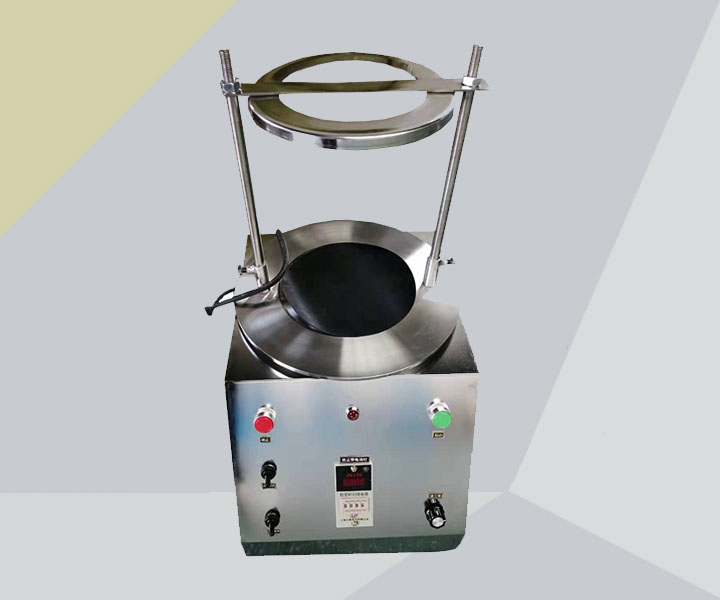
Screening accuracy: 5μm
Price: $450.00 - $1,000.00/ Sets
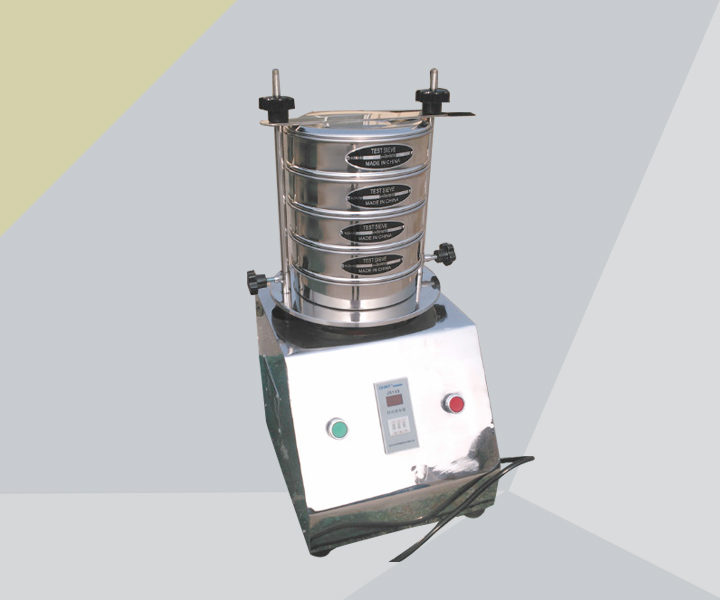
Measuring range: 20µm - 125mm
Price: $520.00/Sets
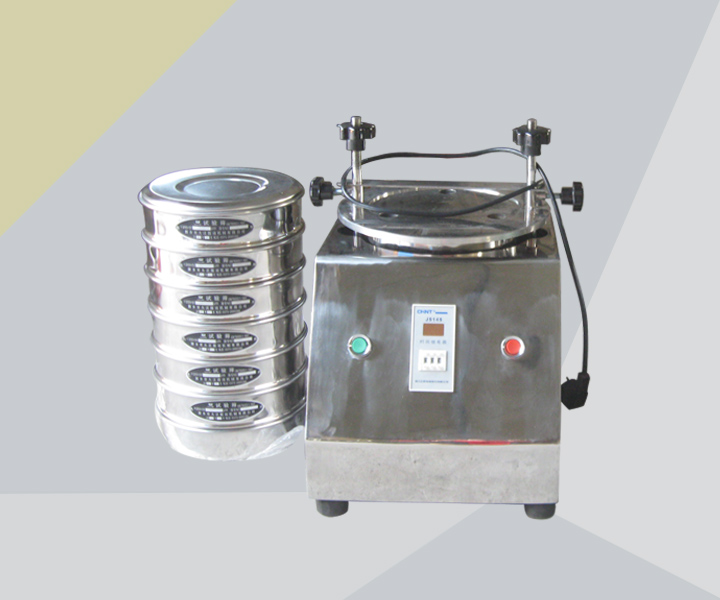
Screening particle size: 0.025mm-3mm
Price: $650.00 - $800.00/Set
Sep 09, 2026
How to Properly Clean and Maintain Ultrasonic Test Sieves
Learn proper cleaning steps, routine maintenance and common mistakes for ultrasonic test sieves. Exte...
Sep 09, 2026
ISO 3310-1 vs. ASTM E11: A Comprehensive Technical Comparison for Global Laboratories
This article compares the technical specifications of ISO 3310‑1:2016 and ASTM E11‑24 sieve testi...
Sep 09, 2026
Sonic Sieve Shaker for Pharmaceutical Granules
Sonic Sieve Shaker for Pharmaceutical Granules separates drug particles of different sizes through si...
Sep 09, 2026
Ultrasonic Sieves for Fine Powder
Ultrasonic Sieves for Fine Powder adds an ultrasonic system to a regular vibrating screen, enabling t...

Then we look forward to hearing from you