
WhatsApp:+86 15236742901

Email:sale@xxdahan.com


WhatsApp:+86 15236742901
Email:sale@xxdahan.com
Wednesday September-09 2026 16:41:58
Mechanical Sieve Shaker can perform particle grading and particle size analysis. Operators stack standard sieves of different mesh sizes, pour material onto the top sieve, and the equipment uses vibration or oscillation to separate particles layer by layer on the sieve surface. Basic models suitable for routine sieve recording are priced between $350 and $900; models with timer control and multi-layer sieve frames generally range from $900 to $4000. This mechanization, replacing manual shaking, not only shortens testing time but also avoids errors caused by fluctuations in human physical strength.
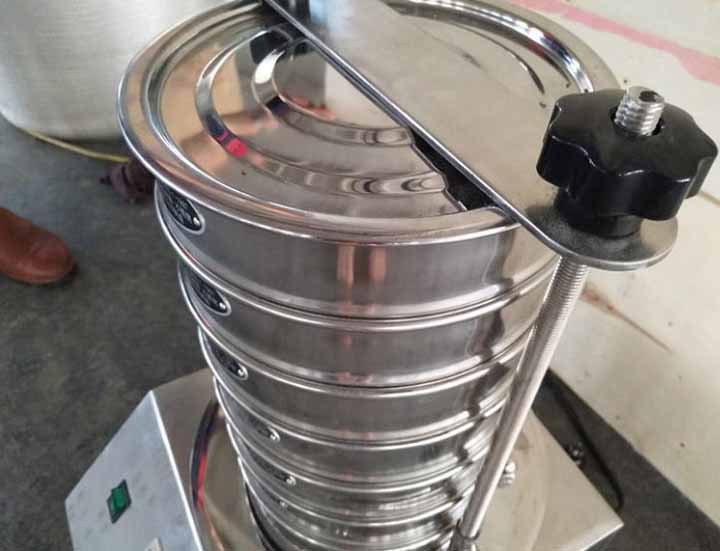
Price differences are usually not determined by a single configuration but rather by a combination of structure and usage scenario. When comparing prices for mechanical sieve shakers, several details are key considerations.
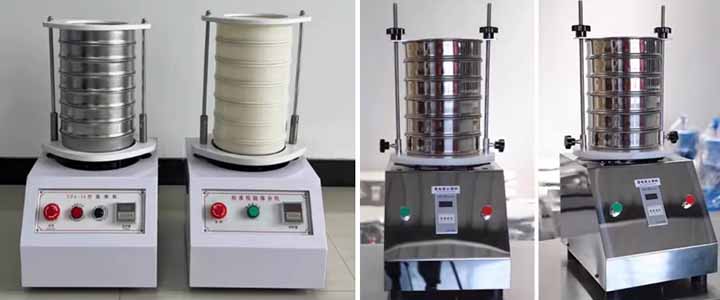
Machines with a carbon steel spray-painted casing are less expensive than those with stainless steel casings and are suitable for dry powder environments. Using a 304 stainless steel welded casing increases the overall cost by up to 10%, and is more common in dusty mineral or plastic powder workshops because it prevents powder residue from remaining in the weld seams when cleaning the screen frame.
Screen size and number of layers affect the equipment's frame structure. A machine with 8 layers of a standard 200mm screen requires a more stable clamping structure and more uniform vibration transmission during operation, typically costing $400–$1,200 more than a model with only 3 layers. In powder particle size distribution testing, insufficient layers result in excessively coarse grading intervals, affecting data resolution.
Machines with purely mechanical timer knob controls are less expensive, while models with PLC control panels, runtime recording, and digital amplitude adjustment typically cost between $2,000 and $3,500. Some workshops integrate them into the production line control cabinet for batch screening records.
Differences in the place of origin also create price ranges. Chinese-made equipment typically ranges from $400 to $2900; European brands of the same specifications may cost between $3000 and $4000. The differences lie more in the lifespan of the transmission structure, bearing precision, and vibration stability after long-term operation, rather than appearance.
Different structures of sieving equipment cater to different particle states, thus their prices vary. Test Sieve Shakers are mostly used for basic particle size analysis and sieving curve recording in laboratories, costing approximately $550–$1100. They are commonly used for testing samples such as quartz powder and calcium carbonate powder. After sieving, it is usually necessary to disassemble the sieve layer by layer and record the weight change of each layer. Ro-Tap Sieve Shakers are more suitable for easily agglomerated materials, such as graphite powder or some powder substitutes. They use a top cam mechanism to achieve approximately 290 horizontal reciprocating strokes + 150 vertical taps per minute, continuously loosening clogged particles. They cost approximately $1300–$2600 and can reduce the frequency of sieve cleaning in powder processing workshops. Top-impact screens primarily use vertical vibration and are suitable for screening ore particles or coarse powders. They have a large amplitude and require a more sophisticated screen frame structure. Prices range from approximately $900 to $1,700, and they are commonly used in particle size distribution testing of building aggregates.
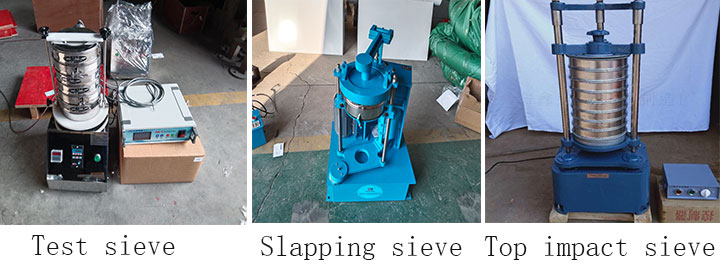
| Equipment Name | Motion Characteristics | Applicable Materials & Scenarios | Common Configuration Specifications | Reference Price Range (USD) |
| Standard Test Sieve Shaker | Vertical Vibration or 3D Rotary Vibration | Ordinary dry powder, sand, metal powder; sampling inspection | Fit Φ200/Φ300 sieves; stack 1-8 layers; digital display timing | $550 – $1,300 |
| Ro-Tap Sieve Shaker | Reciprocating Rotation + Top Mechanical Tapping | Easy-adhesive, easy-blocking, ultra-fine or irregular powder | Reciprocating speed 290 times/min; tapping speed 156 times/min | $1,300 – $2,600 |
| Vertical Impact Sieve Shaker | Bottom Rotation + Vertical Reciprocating Impact | Coarse particles, high-hardness ore, coal analysis | Impact frequency 147 times/min; suitable for high-throughput coarse screening | $900 – $1,700 |
When selecting screening equipment, the application must be considered. For laboratories typically processing 50–200g powder samples and recording data changes across 3–5 screen layers, a 200mm benchtop unit is sufficient. Budget ranges are usually linked to control precision. If the budget is low, a basic mechanical timed structure is more suitable; when the budget increases to around $3,000, models with multi-level amplitude adjustment and data recording capabilities can be considered. In particle size distribution testing scenarios, even a time error of only a few seconds can affect the calculation of fine powder throughput.
The price difference of mechanical sieve shakers stems more from structural design and the usage environment than from a single parameter. By comparing different motion modes such as tapping and vibration, and considering the specific throughput requirements of the laboratory, reliable particle size distribution data can be obtained while controlling costs. In actual procurement, many users initially focus only on the price range, but after experiencing the prototype, they readjust their choices. For example, they may find that insufficient screen layers affect particle distribution assessment, or that mismatched vibration modes lead to prolonged screening times. These details often reflect the real-world user experience more closely than price quotes.
Sep 09, 2026
Mechanical Sieve Shaker Price varies depending on the model. The basic model, suitable for routine sc...
Sep 09, 2026
How to Properly Clean and Maintain Ultrasonic Test Sieves
Learn proper cleaning steps, routine maintenance and common mistakes for ultrasonic test sieves. Exte...
Sep 09, 2026
ISO 3310-1 vs. ASTM E11: A Comprehensive Technical Comparison for Global Laboratories
This article compares the technical specifications of ISO 3310‑1:2016 and ASTM E11‑24 sieve testi...
Sep 09, 2026
Sonic Sieve Shaker for Pharmaceutical Granules
Sonic Sieve Shaker for Pharmaceutical Granules separates drug particles of different sizes through si...

Then we look forward to hearing from you