
WhatsApp:+86 15236742901

Email:sale@xxdahan.com


WhatsApp:+86 15236742901
Email:sale@xxdahan.com
Thursday May-07 2026 15:26:49
If you are preparing to purchase laboratory screening equipment for particle size testing, vibration screening test sieve is one of the common devices used to sort dry, damp or free-flowing bulk materials. The device relies on regular vibration to separate particles of different sizes, and can run in batch intermittent mode or continuous feeding mode, fitting daily laboratory testing and routine sample inspection work.

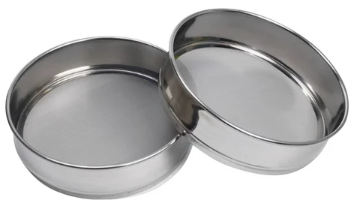
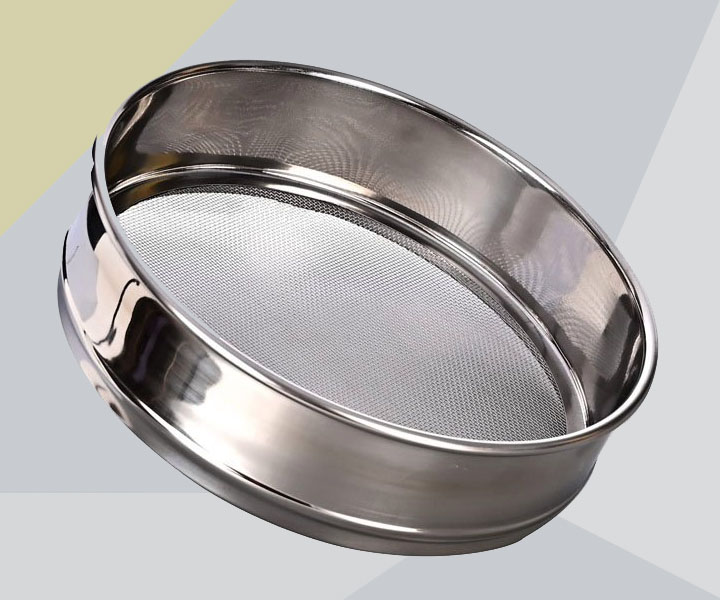
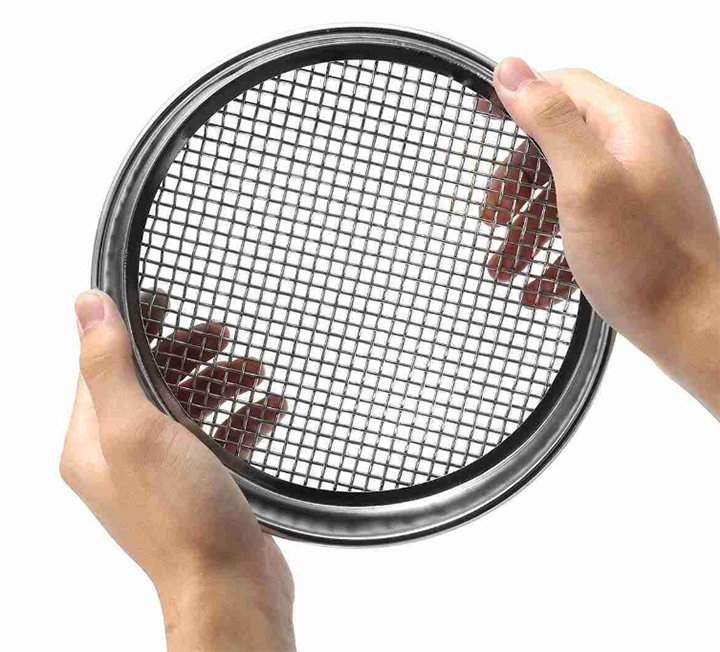
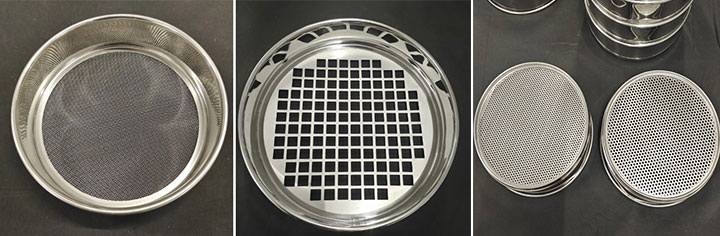
This type of test sieve is assembled with sieve frame and sieve mesh as two basic parts.
Sieve frames are mostly made into round shape, 200mm and 300mm are the two sizes you can see most often in laboratories. Frame height generally falls between 50mm and 100mm. Raw material choices are stainless steel and aluminum alloy. Stainless steel can stand long-term contact with corrosive dust and particles, and does not easily deform after years of vibration. Aluminum alloy weighs much less, easy to stack on storage racks and move between test benches.
Sieve mesh sets the particle division standard for the whole screening process. Mesh aperture varies from several microns up to several millimeters, covering most powder and granular samples in routine testing. Mesh production follows ASTM, ISO and GB unified specifications, so test data can be compared with industry standard results. Mesh edges are fixed to the frame by clamping or spot welding, avoiding mesh displacement when the device runs for a long time.
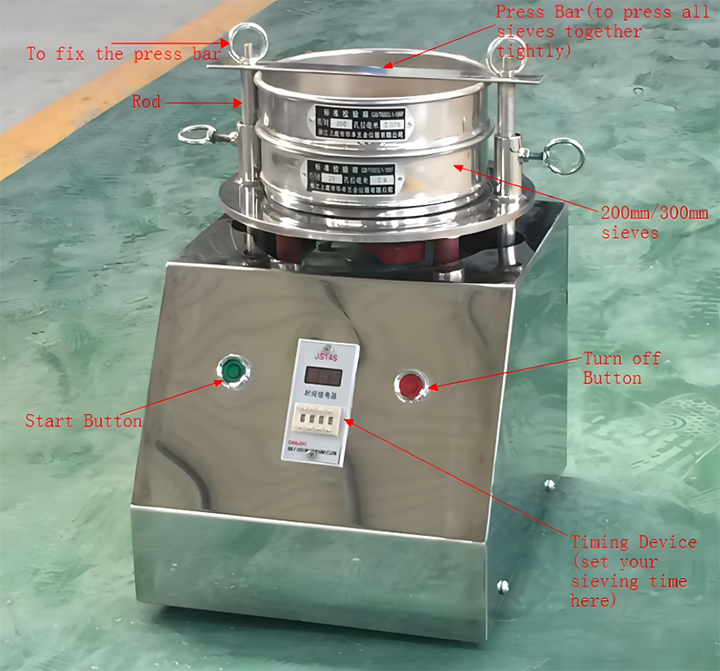
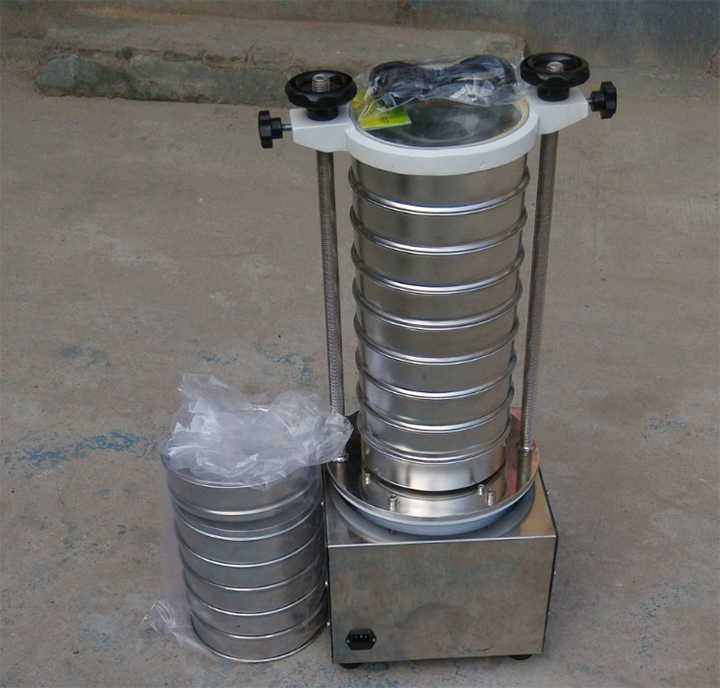
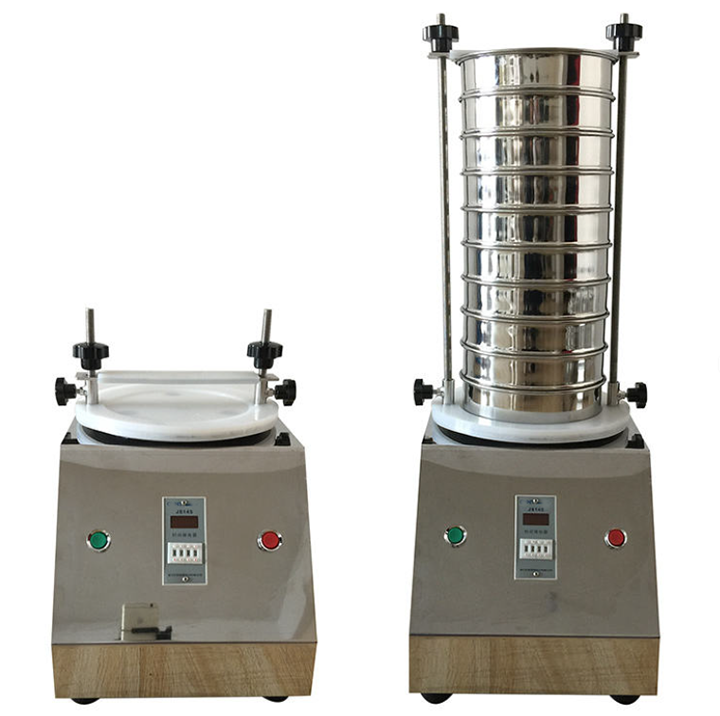
When running a particle test, stacked test sieves are placed on the vibration base, and prepared material samples are poured into the top sieve layer.
With the machine running, the whole sieve set keeps stable vibrating. Smaller particles pass through the mesh holes and fall to the lower layer one by one, while larger particles stay on the corresponding sieve surface. After a set running time, particles are naturally divided into different grades by size.
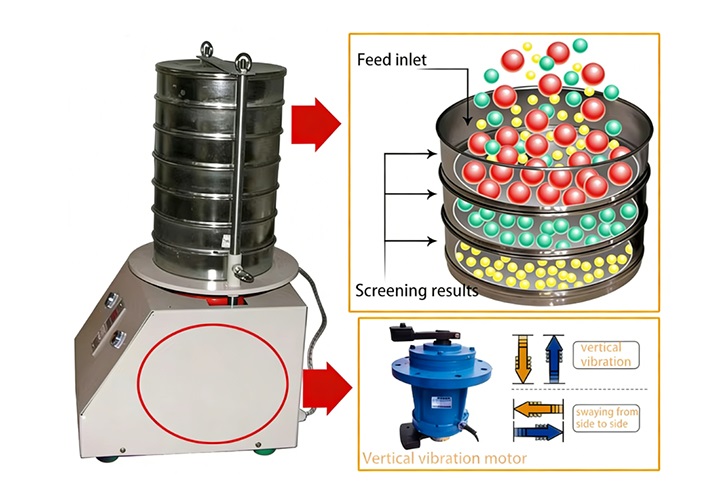
Manual screening relies on personal hand shaking, the force and rhythm differ from person to person, making test results hard to repeat. Vibration generated by the machine keeps consistent frequency and amplitude all the time. When testing fine powder and high-density granular materials, the particle layering state stays stable, and test data will not fluctuate due to manual operation differences.
On the market, vibration screening test sieve is grouped by the way vibration is generated. Three common types are electromagnetic driven type, motor mechanical type and hand-operated type. Electromagnetic and mechanical models can stack 1 to 8 layers of sieves at one time, sorting materials into multiple particle grades in a single test run.
Electromagnetic Vibration Test Sieve
Vibration comes directly from electromagnetic vibrator components, driving the sieve to produce slight linear high-frequency shaking. Vibration frequency ranges from 1200 to 3000 times per minute, and vibration amplitude can be adjusted between 1mm and 3mm. It can process material particles between 0.02mm and 5mm.
Vibration intensity can be changed by adjusting current and frequency according to sample characteristics. The machine runs with low operating noise, suitable for fine powder, light bulk materials and slightly sticky samples that need delicate screening in closed laboratory environments.

Mechanical Vibration Test Sieve
This model uses ordinary motor as power source, with eccentric wheel and spring components to create vibration movement. Its amplitude stays around 3–6mm, and vibration frequency is controlled at 800 to 1500 times per minute. It suits particle samples from 0.5mm to 20mm in size.
During operation, materials are tossed slightly on the sieve surface and spread evenly by vibration. The structure is assembled with conventional mechanical parts, easy for daily inspection and part replacement. It is often placed in sample pretreatment areas for raw material grading before formal experiment analysis.
Manual Vibration Test Sieve
This style needs no power connection. Operators shake the side crank or tap the sieve frame lightly to create vibration. Sieve frame sizes are mostly 100mm to 200mm, matching mesh aperture from 0.05mm to 5mm.
It fits small-batch sample checking and simple preliminary classification work, and often appears in school laboratory teaching and basic sample preparation steps. The whole set takes little storage space, but processing speed is slow, and particle layering effect is affected by manual operation habits.
| Model Type | Vibration Frequency | Amplitude Range | Applicable Particle Size | Common Sieve Diameter | Power Mode |
|---|---|---|---|---|---|
| Electromagnetic Vibration Test Sieve | 1200–3000 times/min | 1–3 mm | 0.02–5 mm | 200mm / 300mm | Electromagnetic adjustable current |
| Mechanical Vibration Test Sieve | 800–1500 times/min | 3–6 mm | 0.5–20 mm | 200mm / 300mm | Motor driven with eccentric wheel |
| Manual Vibration Test Sieve | Subject to manual operation | Subject to manual operation | 0.05–5 mm | 100mm / 200mm | No power supply needed |
Materials placed on the sieve surface spread outward in a spiral track along with vibration rhythm. The spreading state lets samples cover the whole mesh area evenly, preventing raw materials from piling up in one corner and causing incomplete particle separation.
Vibration frequency and amplitude can be tuned according to material density, surface viscosity and natural humidity. For loose dry sand samples and sticky wet powder, operators can adjust running parameters to match actual test conditions.
Sieve frames and mesh accessories follow unified industry making standards. Mesh aperture size, metal wire diameter and weaving method all follow fixed production rules. Test records from different batches can be filed and referenced for later material comparison.
Many raw materials in industrial and laboratory environments need particle size inspection, such as quartz sand, abrasive grains, metallurgy powder, grain flour, edible salt, crystal sugar, tea raw materials, coal powder, farmland soil samples, sludge particles and industrial solid waste fragments.

The device can separate powder and granular raw materials to record particle size distribution data. It can also screen out mixed foreign matter and oversized particles in raw material batches. Multiple particle grades can be separated in one screening process, matching small-batch sample sorting and daily laboratory research work. Production line intermediate materials and finished products can also be sampled and screened to check whether particle status matches production process requirements.
After each batch of testing, residual powder on the mesh can be cleaned with soft bristle brushes. Ultrasonic cleaning tools and dedicated mesh washing equipment can also be used for regular deep cleaning. For materials that easily stick to the mesh surface, auxiliary air blowing equipment or heating auxiliary structures can be fitted to clear residual particles.
Operators can check and calibrate vibration frequency and amplitude at fixed intervals, keeping material spreading and layering in normal state. Lubricating grease inside mechanical parts needs periodic refilling and replacement. Bearing working temperature and sealing ring status can be checked regularly to avoid abnormal shutdown caused by part aging.
We make test sieve equipment following existing industrial production norms, with complete production and inspection procedures. For materials with special viscosity, humidity or special particle characteristics, we can adjust structural configuration and provide matching layout suggestions according to actual on-site use conditions.
May 07, 2026
vibration screening test sieve
Vibration screening test sieves use vibration to separate particles by size for material testing, par...
Apr 22, 2026
material separation test sieve
material separation test sieve enables precise material separation, simplifying powder classification...
Apr 22, 2026
test sieve for powder and material
test sieve for powder and material is used to determine particle size distribution and impurity conte...
Apr 07, 2026
Ultrasonic Sieves for Fine Powder
Ultrasonic Sieves for Fine Powder adds an ultrasonic system to a regular vibrating screen, enabling t...

Then we look forward to hearing from you