
WhatsApp:+86 15236742901

Email:sale@xxdahan.com


WhatsApp:+86 15236742901
Email:sale@xxdahan.com
![[field:title/]](/uploads/260609/1-2606091J61W20.jpg)
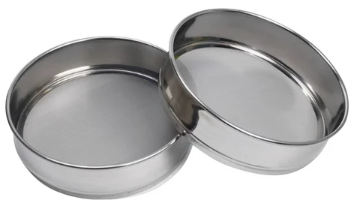
In particle size analysis, technicians often encounter problems such as fine powder clogging the mesh or data distortion caused by mesh displacement during vibration. Ordinary industrial sieves have large tolerances, easily missing particles exceeding the standard. Stainless Steel Laboratory Test Sieves, however, offer non-deformable standardized meshes, manufactured strictly according to standards, with sieve openings covering 20 to 125 micrometers, solving the problem of separation consistency and accurately measuring the true distribution of particles of various sizes.
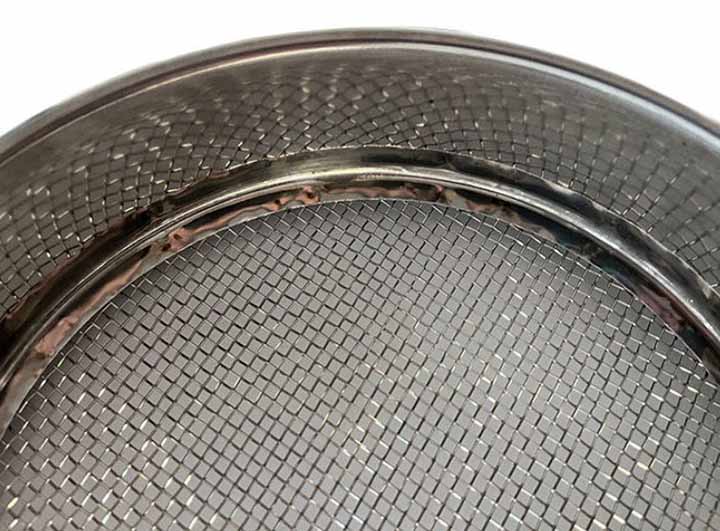
The SUS304 and SUS316 stainless steel materials are rust-resistant and acid and alkali-resistant, avoiding the drawbacks of traditional brass sieves such as oxidation, deterioration, and residual metal impurities. Their inert structure prevents chemical contamination of samples during testing.
Using laboratory-grade stainless steel standard sieves provides long-term durability and reliable repeatable testing. Seamless laser welding eliminates gaps at the connection between the sieve mesh and frame, preventing particle retention, simplifying the cleaning process, and avoiding cross-contamination between different batches of samples. The mesh is mechanically stretched before fixing, ensuring uniform tension and preventing sagging even under continuous heavy loads from the vibrating screen. It maintains stable aperture dimensions even after years of use. The tightly nested design ensures a seamless fit between the top and bottom edges of the screen frame, allowing multiple screens to be stacked securely without wobbling, preventing dust leakage into the air.
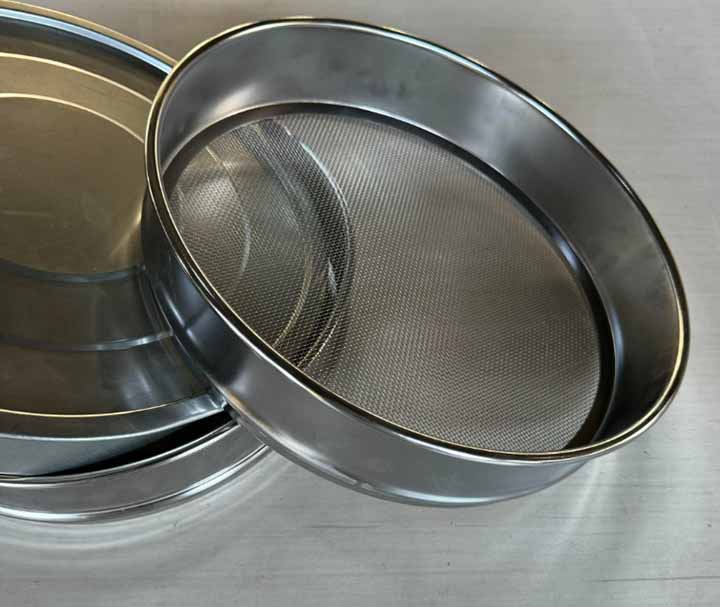
Stainless steel laboratory test sieves strictly comply with ISO 3310-1 (International Standard) and ASTM E11 (American Standard).
| Sieve Frame Diameter | Sieve Body Height | Aperture Range | Mesh Range | Typical Materials & Applications |
| 200 mm / 8 inch |
50 mm (Full) 25 mm (Half) |
20 μm - 4.00 mm | 5 Mesh - 635 Mesh | Metal powder, lab micro samples, flour, pharmaceutical powder |
| 300 mm / 12 inch |
60 mm (Full) 30 mm (Half) |
38 μm - 25.0 mm | 1 Mesh - 400 Mesh | Manufactured sand, soil, river sand, catalyst grading |
| 400 mm / 16 inch | 85 mm (Full) | 1.00 mm - 125 mm | Coarse Screen / Perforated Plate | Ore, coal, large crushed stone, grain impurity screening |
The price of a single stainless steel laboratory standard sieve typically ranges from $35 to $280. As it is a metrological tool, the price depends on the specific configuration and is not fixed. Two variables influence cost: first, the mesh size. Coarse screens (2mm to 10mm) are simple to manufacture and cost between $35 and $60, while ultrafine screens (below 45 microns) require special micro-wire weaving and cost over $150. Second, the screen frame diameter. Standard 200mm frames are cheaper to produce in bulk, while larger 300mm or 400mm frames require more raw materials and custom packaging, thus increasing the price.
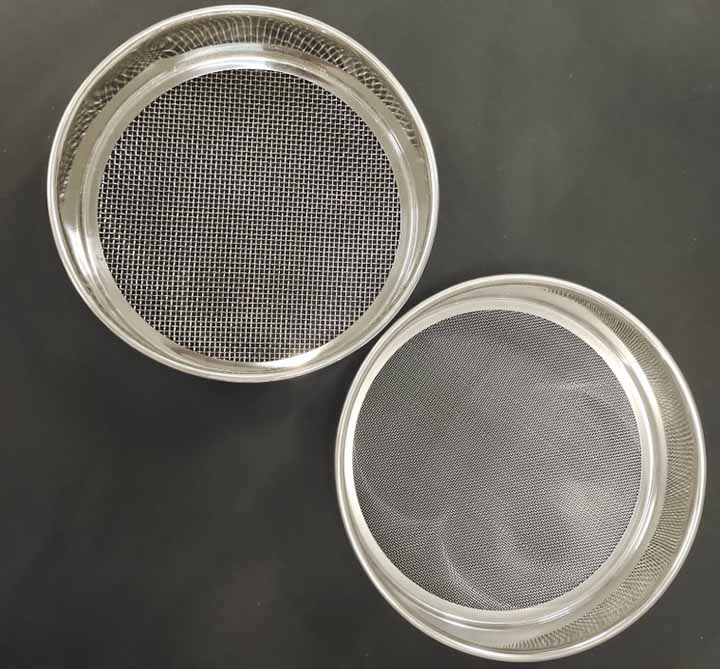
| Material Type | Core Features | Application Scenarios & Materials |
| SUS304 Stainless Steel | Standard material, cost-effective, daily oxidation resistance | Dry non-corrosive powder; construction sand & cement; grain & flour |
| SUS316 Stainless Steel | With molybdenum, better pitting & acid-alkali resistance | Salty & chemical powder; strong acid/alkali raw materials; wet screening |
Particle testing requires analyzing the physical properties of materials from different industries. Applications include: in powder metallurgy and 3D printing, technicians use 45-micron and 63-micron sieves to separate spherical titanium powder from stainless steel particles, preventing excessively large particles from clogging nozzles; in civil engineering, geotechnical laboratories stack coarse sieves to classify quartz sand, crushed granite, and concrete aggregates to calculate the load-bearing capacity of the mixture; in the flour milling industry, millers use them to sieve wheat bran and rye flour to monitor starch damage and ash content, as regulations prevent the use of brass sieves; in battery manufacturing, production lines use them to inspect synthetic graphite and lithium iron phosphate powder, controlling narrow particle distribution to improve battery energy density.
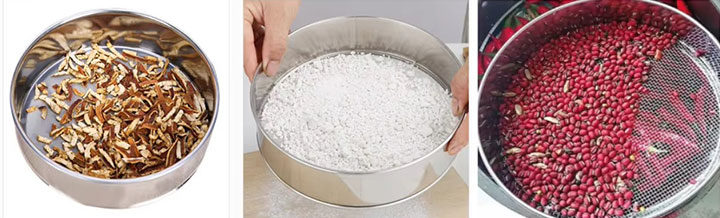
A: It serves as a physical reference standard, separating bulk particle samples into different size fractions. By stacking multiple standard sieves on a sieving machine, laboratory operators can measure the percentage of material weight that passes through or remains on each sieve layer.
A: Apply a molybdenum element detection solution to the metal surface. If it turns dark red within 30 seconds, it indicates a high manganese content, indicating a lower grade of 201 steel. Genuine SUS304 contains chromium and nickel and resists color change under standard acid point testing.
A: An ASTM E11 standard 80 sieve has a nominal sieve aperture size of 180 micrometers (0.180 mm). The wire diameter is approximately 131 micrometers, leaving approximately 33.6% of the open area for material passage.
A: Do not use a wire brush to prevent pore deformation. Immerse in an ultrasonic bath with a mild detergent for 5-10 minutes, rinse with distilled water, and then dry in an oven below 60°C to prevent thermal expansion from damaging the mesh tension.
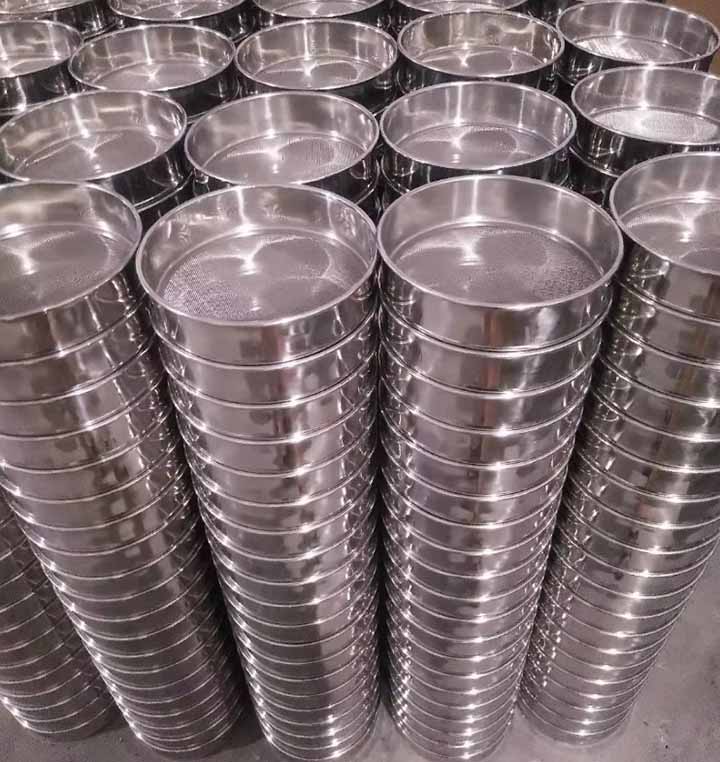
Stainless steel laboratory standard sieves are tools for separating particle size distributions in powder production and civil aggregate testing. Their SUS304 or SUS316 construction prevents sample contamination while resisting wear from high-frequency vibrations. When selecting a configuration, evaluate the sieve aperture size, sieve frame height, and certification requirements to match your laboratory sieving setup. To request a volume selection option to match your sieve list or a formal price estimate, please submit your specifications through our website contact portal.
Ultrasonic Sieves for Fine Powder
Ultrasonic Sieves for Fine Powder adds an ultrasonic system to a regular vibrating screen, enabling the sieving of fine powders...
cement fineness test sieve is a commonly used sieving tool in cement physical property testing...
Precise test sieves, also known as standard sieves, inspection sieves, particle size analysis sieves, or sample sieves, are precision sieving...
Sonic Sieve Shaker for Metal Powder Testing
Metal powders possess unique physical properties. When particle size decreases to the micrometer level...
Stainless Steel Test Sieve For Pharmaceutical Powder
Stainless Steel Test Sieve For Pharmaceutical Powder can be used to detect the particle size of pharmaceutical powders and separate powders of different coarseness...
Test Sieve For Cement Fineness Testing
Test Sieve For Cement Fineness Testing are common screening tools used in cement production, quality inspection, and engineering construction to determine the fineness of cement particles...
Are you interested?

Then we look forward to hearing from you