
WhatsApp:+86 15236742901

Email:sale@xxdahan.com


WhatsApp:+86 15236742901
Email:sale@xxdahan.com
Wednesday September-09 2026 09:42:07
The accuracy of particle size analysis in the laboratory depends heavily on the choice of sieve shaker. The wrong equipment can lead to irreproducible data, frequent sieve blinding, or even complete test failure – a dilemma that many lab managers and quality control engineers face regularly.
Among the various sieving technologies, the mechanical Ro-Tap sieve shaker and the electromagnetic sieve shaker represent the two most prevalent approaches on the market. With over a century of history, the Ro-Tap has established itself as an industry benchmark through its unique mechanical tapping action, while electromagnetic shakers offer a quieter, more controllable alternative, gaining ground in fine powder applications.
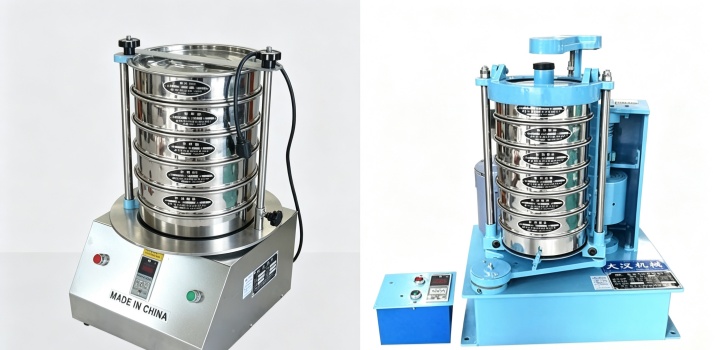
This article is designed to help laboratory managers, QC engineers, and production specialists make the right selection based on their specific material characteristics and testing requirements.
Ro-Tap Sieve Shaker – Overview
Working principle
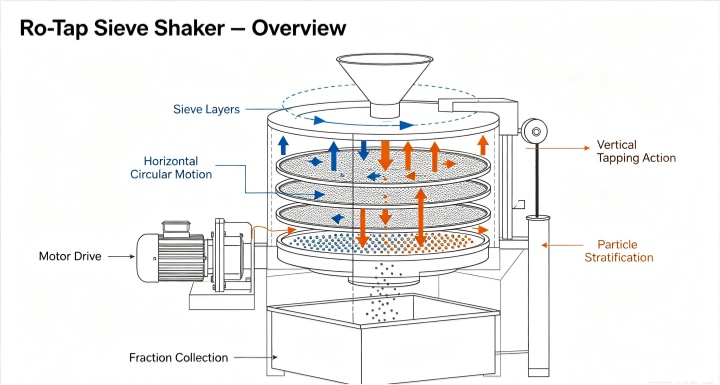
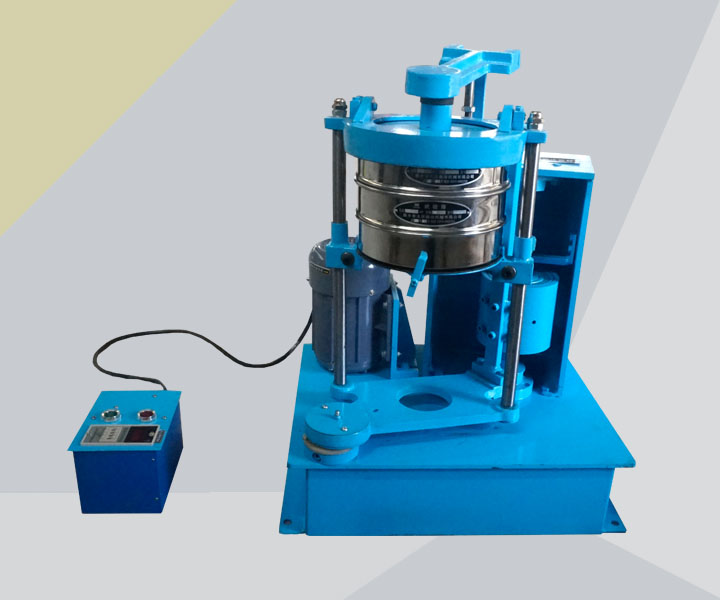
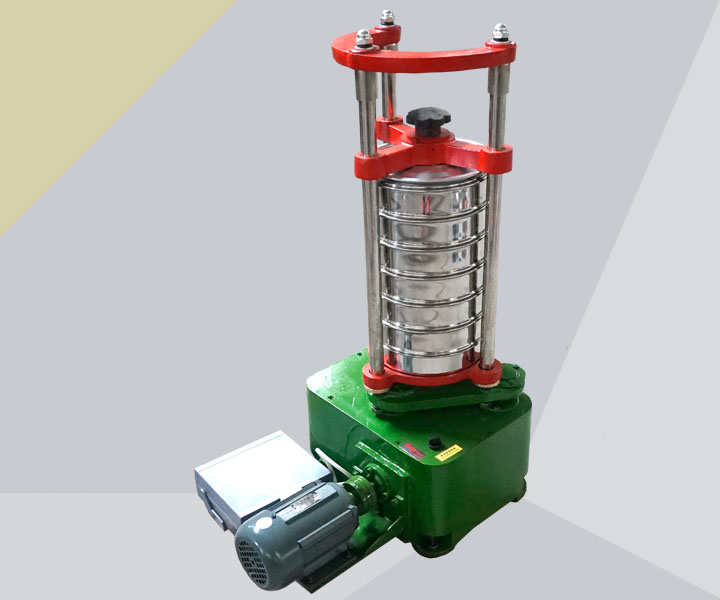
The Ro-Tap shaker employs a unique two-dimensional compound motion – horizontal circular rotation
combined with a vertical tapping (hammer) action. Powered by a fully enclosed 1/4-hp motor, it simultaneously generates both rotary and tapping movements. This mimics manual sieving, allowing particles to stratify on the sieve surface and actively “search” for the apertures.
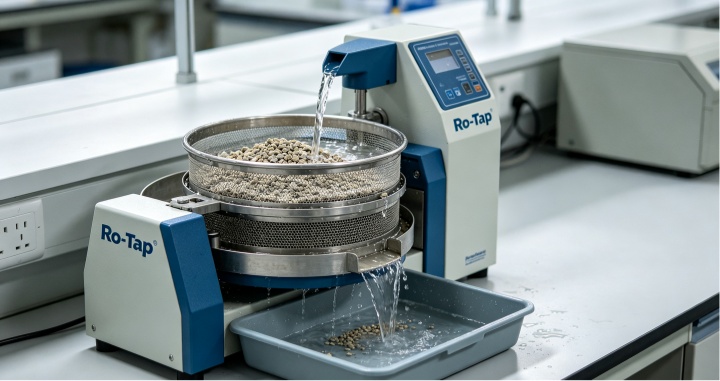
Key features: The tapping force effectively dislodges particles that become stuck in the mesh, preventing sieve blinding. This vigorous mechanical action works exceptionally well for a wide range of free-flowing granular materials and aggregates. For example, the classic RX-29 model operates at an oscillation frequency of 278±10 rpm and a tap rate of 150±10 taps/min, accommodating up to 6 full-height sieves or 13 half-height sieves, with mesh sizes ranging from 20 µm to 125 mm. Additionally, the Ro-Tap is compatible with dedicated wet-sieving accessories, making it suitable for materials that tend to cake in the presence of moisture or for tests that require water-washing analysis (e.g., cement raw materials, natural aggregates).
Electromagnetic Sieve Shaker – Overview
Working principle
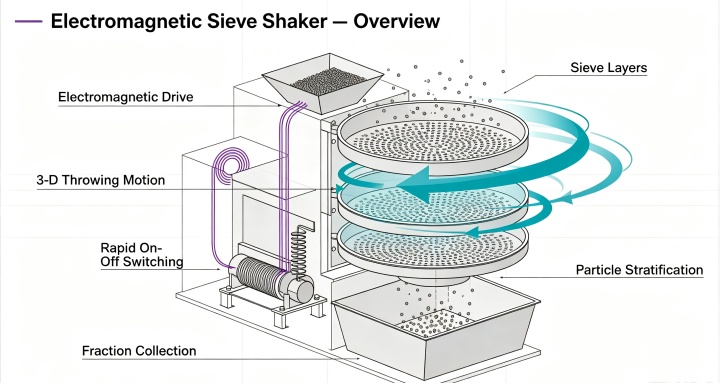
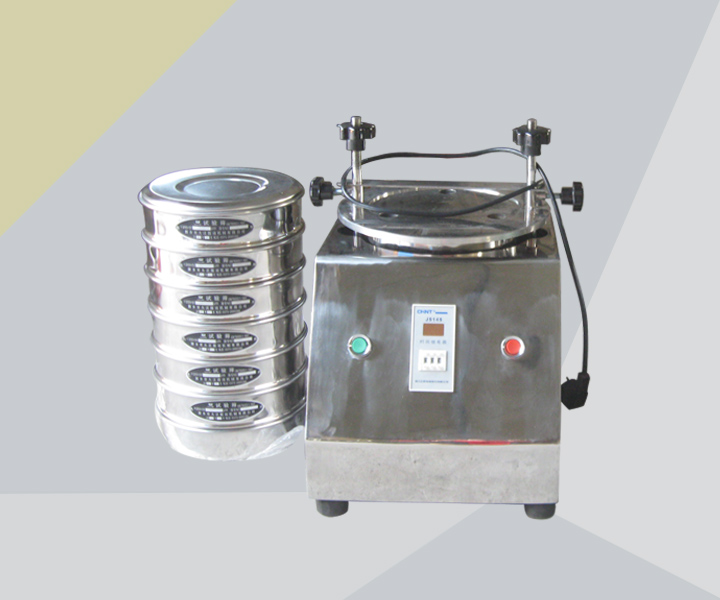
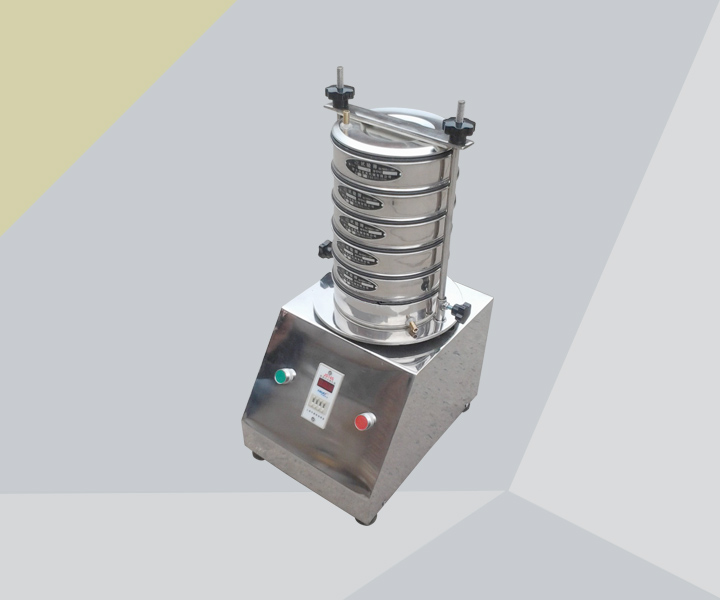
Electromagnetic shakers use an electromagnetic drive to generate a three-dimensional throwing motion. The rapid on-off switching of the electromagnet causes the excitation unit to vibrate, imparting a 3-D throwing action to the sample. Unlike mechanical shakers, electromagnetic units have no moving transmission parts – no belts, gears, or eccentric weights.
Key features: They operate at high vibration frequencies – up to 3,000 rpm – with acceleration forces reaching 9 g. The amplitude (typically 1–2 mm) can be adjusted in steps to suit different materials. This high frequency micro vibration is particularly effective for dry, fine powders. However, standard electromagnetic shakers are not designed for wet sieving; if the material has a high moisture content, it must be pre-dried before testing.
Motion Pattern & Sieving Efficiency
Ro-Tap: The rotary motion spreads the sample evenly across the sieve surface, while the tapping action mechanically dislodges near size and elongated particles. This combination excels for materials prone to blinding and for applications demanding high repeatability. Irregularly shaped particles benefit from the repeated impact, which encourages them to re-orient and pass through the apertures.
Electromagnetic: The pure 3D throwing motion moves the sample in a spiral path across the sieve. This is highly efficient for dry, free flowing fine powders, but it provides less driving force for large, heavy, or irregular particles.
Suitable Materials & Particle Size Range
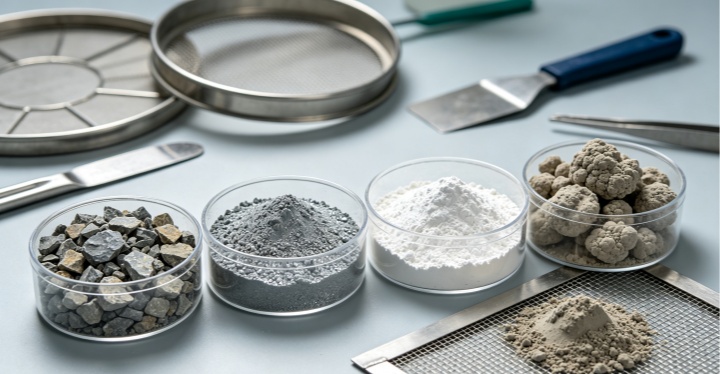
Ro-Tap: Widely used in mining, construction aggregates, metal powders, abrasives, and more. The RX-29 covers a test range from 2 inches (~50 mm) down to 635 mesh (20 µm). Whether it is sand, crushed stone, ores, or heavy metal powders that tend to block the mesh, the Ro-Tap delivers dependable results. For methods requiring wet separation, the Ro-Tap remains the preferred choice in many QC laboratories.
Electromagnetic: More adept at dry, fine, lightweight, or friable powders. In dry sieving applications, its effective range typically spans from 20 µm up to several millimetres, making it ideal for pharmaceuticals, fine chemicals, food powders, and similar quality control tasks. A critical note: For particles <45 µm, electrostatic charges and agglomeration effects become significant; relying solely on electromagnetic vibration may not yield optimal separation. If your application involves sub micron ultra fine powders or highly agglomerative materials, we recommend considering air jet sieving with negative pressure dispersion or ultrasonic assisted systems to obtain a true particle size distribution.
Noise Level
Ro-Tap: The mechanical tapping generates considerable noise – around 85-86 dB(A) for the RX-29. For smaller labs where operators are in close proximity, this is a genuine concern. Sound enclosing cabinets are available as an option, reducing noise to approximately 78 dB.
Electromagnetic: With no mechanical impact or gearing, these shakers run very quietly – typically below 70 dB. This makes them ideal for noise sensitive environments.
Maintenance Costs
Ro-Tap: The mechanical drive includes motors, belts, gears, and eccentric components that experience normal wear over time. Although the units are robust, periodic replacement of consumables is required – maintenance kits range from approximately $165 for minor refurbishment to $767 for major overhaul kits.
Electromagnetic: Since there are no moving transmission parts, maintenance is virtually negligible – no belts to replace, no gears to lubricate, and no eccentric weights to recalibrate. Over the long term, operating costs are significantly lower than those of mechanical shakers.
Standard Compliance
The Ro-Tap holds an unassailable position in many traditional industry standards. ASTM C136 (“Standard Test Method for Sieve Analysis of Fine and Coarse Aggregates”) is the cornerstone of construction materials testing, and ASTM D5644 explicitly references the Ro-Tap procedure. For laboratories that must strictly adhere to these methods, the Ro-Tap is often the prescribed – or strongly recommended – choice.
Choose the Ro-Tap Sieve Shaker if:
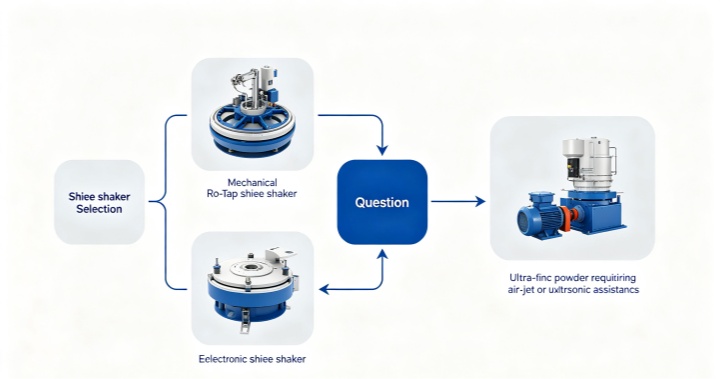
Your test method (e.g., ASTM C136, ASTM D5644) specifically requires or recommends a tapping/sieving action.
You process heavy, dense, or easily blinding materials such as aggregates, ores, or metal powders.
Your samples contain irregularly shaped particles that may not adequately separate on an electromagnetic shaker.
You need the highest level of data repeatability for strict quality control release.
You have large throughput needs (up to 6 full height or 13 half height sieves simultaneously).
You require wet-sieving capability the Ro-Tap can be fitted with dedicated wet-washing accessories.
For more details, consult our [Ro-Tap Sieve Shaker Models & Specifications] to find a configuration tailored to your industry requirements.
Choose the Electromagnetic Sieve Shaker if:
Noise control is a top priority – your lab cannot accommodate a unit running at >85 dB, even with an enclosure.
Your main application is dry, free flowing fine powders (typical range 20 µm to several millimetres).
Your samples are friable or sensitive to mechanical impact – tapping would cause breakage or surface abrasion.
You require high-frequency, precisely adjustable 3D throwing motion to adapt to different materials.
You want to minimise long-term maintenance and operating costs.
However: For ultrafine powders below 45 µm or those prone to agglomeration, evaluate whether additional dispersion techniques (e.g., air-jet sieving, ultrasonics) are necessary to achieve reliable results.
The Ro-Tap and the electromagnetic sieve shaker are not competitors in a winner-takes-all sense; rather, they are complementary solutions designed for different applications.
The Ro-Tap is a century-proven workhorse – its powerful mechanical tapping action copes with heavy, blinding, and irregular materials. It maintains an unrivalled position in mining, aggregates, metal powders, and construction materials, while its wet-sieving accessories extend its utility to water-wash applications. If your standard explicitly specifies a tapping motion, the Ro-Tap is your only choice.
The electromagnetic shaker is a modern upgrade for the contemporary laboratory – quiet, precise, and virtually maintenance free. It shines in dry-powder QC for fine chemicals, pharmaceuticals, and food products. If a quiet working environment and low upkeep are decisive, it deserves serious consideration. Just bear in mind that for <45 µm powders, you may need to explore air-jet or ultrasonic-assisted methods.
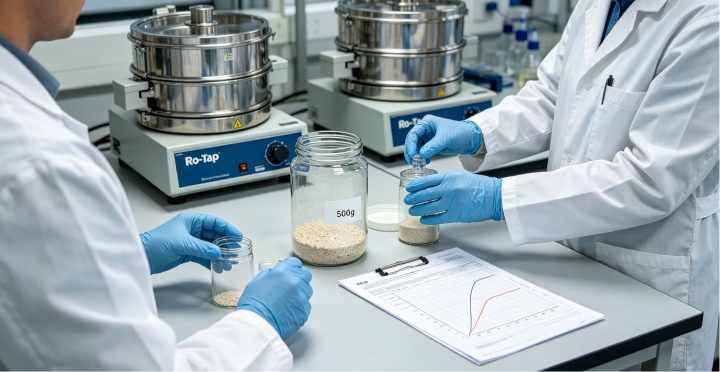
Theoretical parameters can never replace actual test data. We encourage you to send us a 500g representative sample and take advantage of our free “Sample Testing” service. We will run your material side by side on both the Ro-Tap and the electromagnetic shaker in our laboratory, and provide you with two detailed sieve analysis comparison curves – so you can make your final decision based on hard evidence, not guesswork.
Contact us today to request your free sample testing slot or to schedule a one on one technical consultation.
This article is based on general technical specifications and application experience. Final selection should always consider your actual material properties and applicable test standards.
Sep 09, 2026
How to Choose the Right Sieve Shaker: Ro-Tap vs. Electromagnetic Sieve Shaker
Introduction The accuracy of particle size analysis in the laboratory depends heavily on the choice o...
Sep 09, 2026
ISO 3310-1 vs. ASTM E11: A Comprehensive Technical Comparison for Global Laboratories
This article compares the technical specifications of ISO 3310‑1:2016 and ASTM E11‑24 sieve testi...
Sep 09, 2026
How to Properly Clean and Maintain Ultrasonic Test Sieves
Learn proper cleaning steps, routine maintenance and common mistakes for ultrasonic test sieves. Exte...
Sep 09, 2026
Mesh to Micron Conversion Chart
Interactive mesh to micron conversion chart and calculator, with ASTM/ISO standard comparisons and wi...

Then we look forward to hearing from you